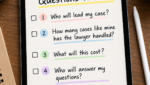

If you’re thinking about divorce, there’s a good chance you’ve already asked an AI tool about it. Maybe you asked ChatGPT how alimony works in Florida. Maybe you asked what happens to the house, or how to prepare before telling your spouse. That’s normal now. Millions of people use AI as a sounding board for the hardest questions in their lives.
Here’s what most people don’t realize: those conversations are not private, and the companies behind these tools have said so themselves.
Are your AI conversations confidential?
No. And you don’t have to take our word for it.
In a widely shared podcast interview, OpenAI CEO Sam Altman said people tell ChatGPT the most personal things in their lives, and that unlike a conversation with a therapist, a doctor, or a lawyer, no legal privilege protects what you type. In his words, “we haven’t figured that out yet.” He acknowledged that if there’s a lawsuit, OpenAI could be required to hand over your conversations.
That’s the head of the company telling you the truth about his own product. When you talk to your attorney, the law protects that conversation. When you talk to a chatbot, you’re sharing your situation with a technology company, and the terms of service you clicked through when you signed up typically allow that company to store your inputs, use them to improve its systems, and turn them over when a court requires it.
Deleting your chats doesn’t fix it either. In ongoing litigation, a federal court ordered OpenAI to preserve user conversations, including ones users had deleted. What you typed may still exist on a server somewhere, whether or not you can see it.
Can your ChatGPT history come up in a Florida divorce?
Florida divorce cases involve discovery, the formal process where each side can request documents, records, and communications relevant to the case. Under Rule 12.280 of the Florida Family Law Rules of Procedure, that scope is broad: text messages, emails, and financial records are routinely produced. Courts are starting to treat AI conversations the same way. In February 2026, a federal court in New York ruled that a person’s conversations with an AI chatbot about his legal situation were not protected by attorney-client privilege and had to be turned over. The reasoning was simple: an AI tool isn’t a lawyer, so talking to it isn’t a confidential conversation with one. That case wasn’t a Florida divorce, and Florida courts aren’t bound by it, but it’s the clearest signal yet of how judges are likely to see these chats.
Now think about what people actually type into these tools during a divorce. Questions about protecting certain assets. Whether an inheritance counts as marital property. What a settlement might look like. What to say, or not say, in mediation. Any of that could be requested by your spouse’s attorney. And if you typed in something your own lawyer told you in confidence, you may have given up the protection on that too. The same federal court held that even privileged communications can lose their protection once they’re shared with a public AI tool.
A question like “how does divorce work in Florida” is harmless. A question that includes your real numbers, your real strategy, or your real spouse is a different story.
Is the information even right?
That’s the other problem, and it’s just as real. AI tools don’t know your county, your judge, what’s already been filed, or the current state of Florida law on your specific issue. They produce confident answers that can be flat wrong, and acting on a wrong answer in a legal proceeding can do lasting damage. We’ve covered this in detail in 7 Reasons You Should Never Use AI Tools Like ChatGPT During a Divorce or Custody Case.
Where should you ask these questions instead?
The questions people type into ChatGPT at midnight are almost always the right questions. They’re just being asked in the wrong place.
When you talk to an attorney, the conversation is privileged. Your spouse’s lawyer can’t subpoena it. It won’t show up in discovery. And the answers you get are about your case, your county, and your facts, from someone who is accountable for getting it right.
Here’s something worth knowing about how we work at Hoffman, Larin & Agnetti: every prospective client speaks with one of our attorneys before signing anything with our firm. Not an intake agent. Not a salesperson. Not an AI bot. An attorney who will listen to your situation and answer your questions honestly, so you can decide what’s right for you.
We’ve been helping South Florida families through divorce for over 40 years. Bring us the questions you’ve been trying to figure out on your own. There’s no cost to speak with us.
Call (305) 653-5555. Text us at (305) 653-1515. Email us at [email protected] or complete the form above, and one of our attorneys will contact you, or reach us at hlalaw.com.
Frequently Asked Questions
Can my spouse’s lawyer see what I typed into ChatGPT?
Potentially, yes. AI chat logs can be requested in discovery like texts and emails, and the platforms themselves acknowledge they may be required to produce user conversations in a lawsuit.
Has a court actually ruled on this?
Yes. In United States v. Heppner (S.D.N.Y. 2026), a federal judge ruled that a person’s conversations with an AI chatbot were not privileged and had to be disclosed. It was a federal criminal case, not a Florida divorce, but courts deciding these questions are likely to follow its reasoning.
Does deleting my AI chat history protect me?
Not reliably. AI companies may retain data after you delete it, and courts have ordered providers to preserve user conversations in active litigation.*
Is it okay to use AI for general legal information?
General questions with no personal details carry less risk, but AI answers about Florida law are often outdated or wrong. For anything specific to your situation, talk to an attorney, where the conversation is actually protected.
This article is for general informational purposes only and is not legal advice. Reading it does not create an attorney-client relationship. For advice about your specific situation, speak with a licensed Florida attorney.
*Clarification:
- In May 2025 the court required OpenAI to keep all ChatGPT logs so the New York Times could investigate its copyright claims.
- On October 9, Judge Wang ended the order, and OpenAI no longer had to preserve logs after September 26.